
Por NuzaBy Nuza
«Nāda brahma: el mundo es sonido.»"Nāda brahma: the world is sound." Máxima del nāda yoga, la rama del yoga dedicada al sonido (Berendt, 1983)A maxim of nāda yoga, the branch of yoga devoted to sound (Berendt, 1983)
Hay una experiencia que casi todos conocemos: estar cerca de una bocina grande y sentir los graves retumbar en el pecho. No lo escuchas nada más, lo sientes en el cuerpo. Eso es el sonido: algo físico, que se mueve y te alcanza.
There's an experience almost all of us know: standing near a big speaker and feeling the bass rumble in your chest. You don't just hear it, you feel it in the body. That's what sound is: something physical, that moves and reaches you.
En este artículo vamos a ver qué es exactamente el sonido, qué le hace a tu cuerpo y a tu mente, qué dice la física, y qué ha encontrado la ciencia cuando pone a prueba el sound healing.
In this article we'll look at what sound exactly is, what it does to your body and your mind, what physics says, and what science has found when it puts sound healing to the test.
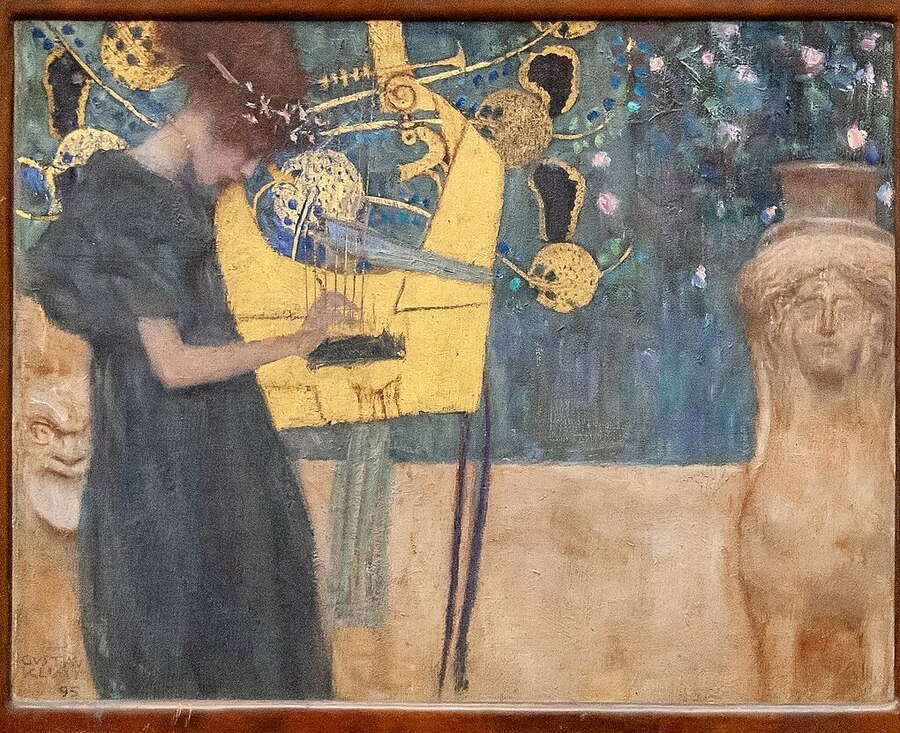
El sonido es algo que tocaSound is something that touches you
El sonido es vibración que viaja. Cuando algo vibra —una cuerda, un cuenco, tus cuerdas vocales— empuja el aire a su alrededor en ondas, y esas ondas viajan hasta encontrarse con algo: un oído, una pared, un cuerpo. La frecuencia es la velocidad de esa vibración, medida en hercios (Hz): cuántas veces vibra por segundo. Pocas vibraciones por segundo se escuchan graves; muchas, agudas.
Sound is traveling vibration. When something vibrates —a string, a bowl, your vocal cords— it pushes the air around it in waves, and those waves travel until they meet something: an ear, a wall, a body. Frequency is the speed of that vibration, measured in hertz (Hz): how many times it vibrates per second. Few vibrations per second sound low; many sound high.
Y aquí viene el dato que explica por qué un baño de sonido se siente en todo el cuerpo: más de la mitad de tu cuerpo es agua, y el sonido viaja por el agua más de cuatro veces más rápido que por el aire. Cuando un gong suena cerca de ti, tus oídos lo escuchan — y el resto de tu cuerpo lo recibe como vibración directa.
And here's the fact that explains why a sound bath is felt all over the body: more than half of your body is water, and sound travels through water more than four times faster than through air. When a gong sounds near you, your ears hear it — and the rest of your body receives it as direct vibration.
La forma del sonidoThe shape of sound
En 1787, el físico alemán Ernst Chladni hizo un experimento que se volvió legendario: esparció arena sobre una placa de metal y la hizo vibrar con el arco de un violín. La arena se acomodó sola en patrones geométricos — distintos para cada frecuencia. Por primera vez, el sonido se podía ver.
In 1787, the German physicist Ernst Chladni performed an experiment that became legendary: he scattered sand over a metal plate and made it vibrate with a violin bow. The sand arranged itself into geometric patterns — different for each frequency. For the first time, sound could be seen.
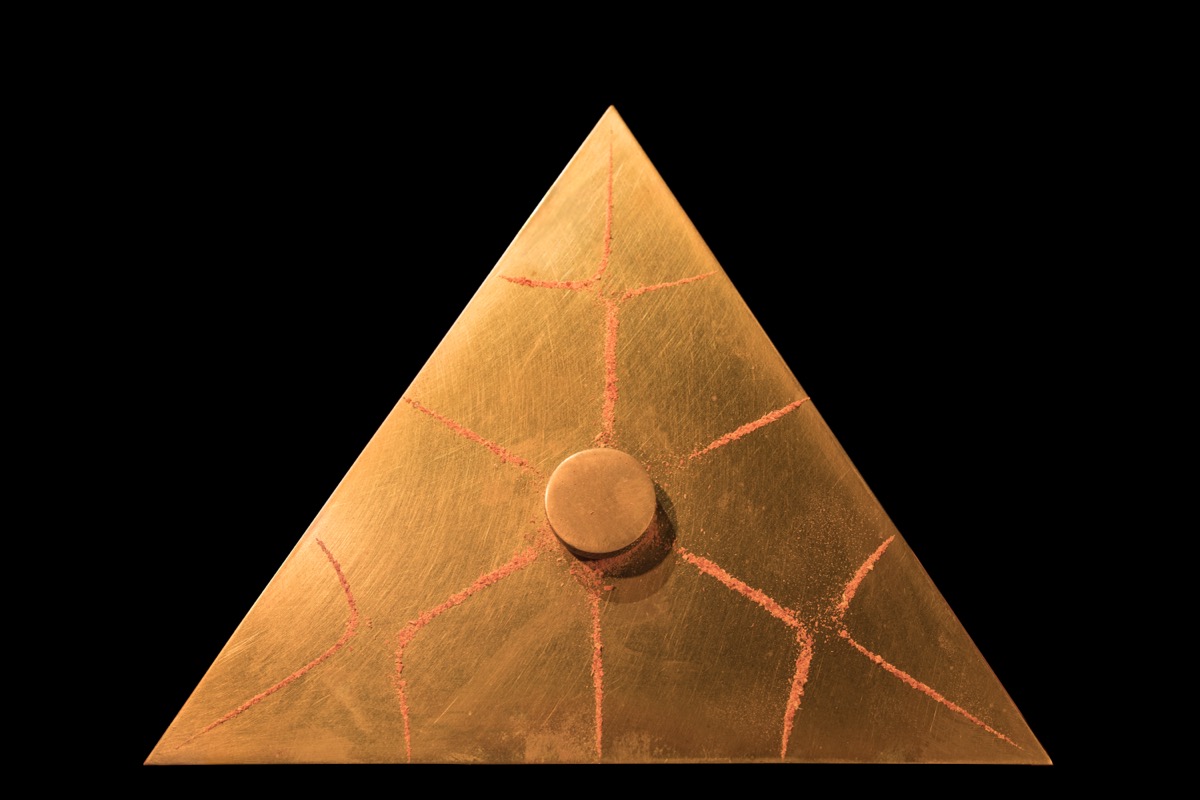
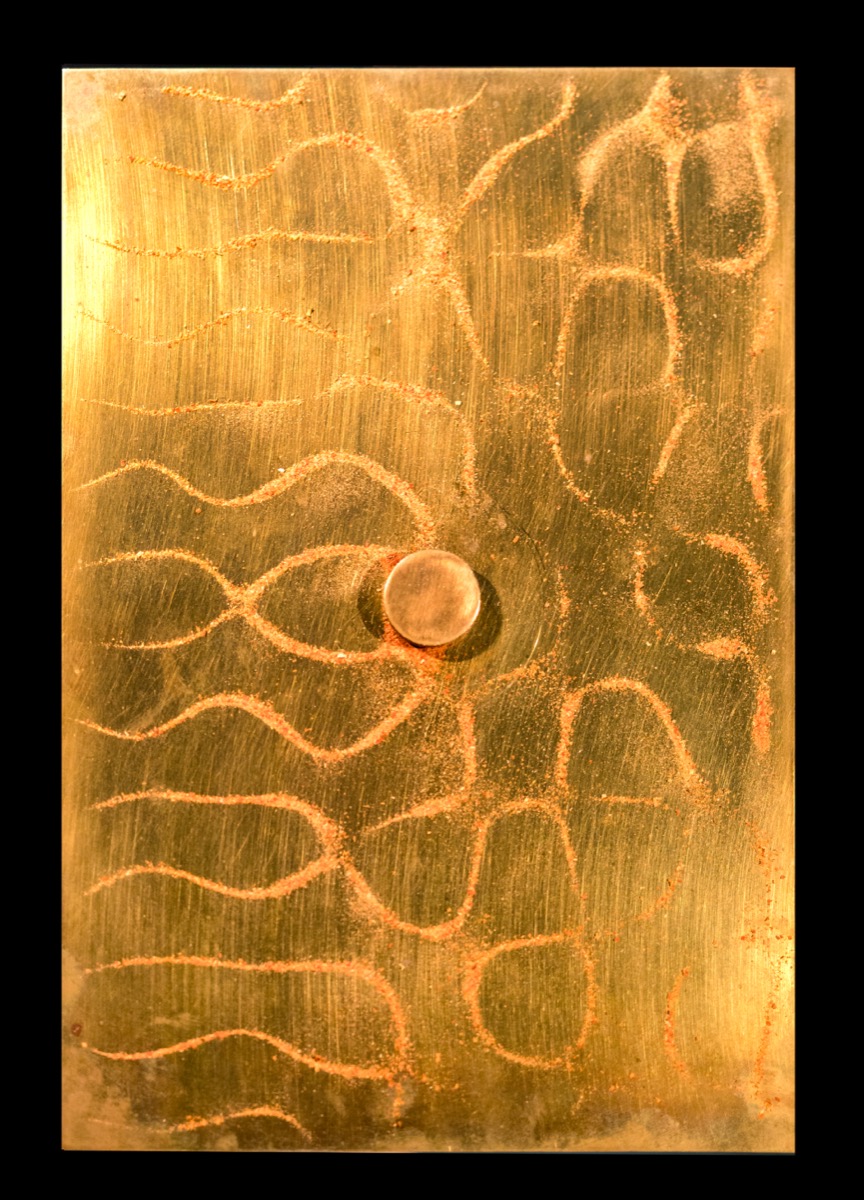
En los años sesenta, el médico suizo Hans Jenny retomó estos experimentos con líquidos y polvos, los fotografió durante años y les puso nombre: cimática, el estudio de cómo el sonido da forma a la materia (Jenny, Kymatik, 1967). Sus imágenes parecen mandalas — y no es casualidad que lo parezcan: son la geometría natural de la vibración.
In the 1960s, the Swiss physician Hans Jenny took up these experiments with liquids and powders, photographed them for years, and gave them a name: cymatics, the study of how sound shapes matter (Jenny, Kymatik, 1967). His images look like mandalas — and it's no accident that they do: they are the natural geometry of vibration.
Todo lo que existe vibraEverything that exists vibrates
Hay un fenómeno que muestra el poder del sonido sobre la materia: se llama resonancia. Quizá hayas visto que una cantante de ópera puede romper una copa con su voz, sin tocarla.
There's a phenomenon that shows the power of sound over matter: it's called resonance. You may have seen that an opera singer can shatter a glass with her voice, without touching it.
Pasa porque cada objeto tiene una vibración propia, como una nota escondida. Si un sonido da justo con esa nota, la copa empieza a vibrar cada vez más fuerte, hasta quebrarse.
It happens because every object has a vibration of its own, like a hidden note. If a sound hits exactly that note, the glass begins to vibrate harder and harder, until it breaks.
Lo interesante es que tu cuerpo también tiene esas notas escondidas. Los huesos, el pecho, los espacios huecos de la cabeza: cada parte responde a ciertas vibraciones. Por eso, cuando un cuenco o un gong suena cerca de ti, no solo lo oyes — algo dentro de ti empieza a vibrar con él.
The interesting thing is that your body also has those hidden notes. The bones, the chest, the hollow spaces of the head: each part responds to certain vibrations. That's why, when a bowl or a gong sounds near you, you don't just hear it — something inside you begins to vibrate with it.
Y si vamos hasta el fondo de la materia, la cosa se pone más interesante todavía. Solemos pensar que las cosas están hechas de piezas sólidas y firmes. Pero la física moderna descubrió que, en lo más pequeño, no hay nada sólido: lo que llamamos materia es, en realidad, energía vibrando. Así que la mesa, tu mano, el aire y tú están hechos de lo mismo: energía en movimiento (Carroll, 2012).
And if we go all the way down to the bottom of matter, it gets even more interesting. We tend to think things are made of solid, firm pieces. But modern physics discovered that, at the smallest scale, nothing is solid: what we call matter is, in fact, vibrating energy. So the table, your hand, the air, and you are all made of the same thing: energy in motion (Carroll, 2012).
Entonces el sonido no necesita ser «mágico» para hacerte bien. Su efecto es concreto y se puede medir: baja el pulso, calma la mente y afloja la tensión del cuerpo. Eso es lo que pasa, de verdad, cada vez que te entregas a un buen sonido.
So sound doesn't need to be "magic" to do you good. Its effect is concrete and can be measured: it lowers the pulse, calms the mind, and loosens the body's tension. That's what really happens, every time you give yourself over to a good sound.
Lo que ha encontrado la cienciaWhat science has found
Empecemos por lo más contundente. Investigadores reunieron 104 estudios clínicos con más de 9,600 personas para responder una sola pregunta: ¿la música realmente baja el estrés? La respuesta fue sí, y no solo «te sientes mejor»: midiendo el cuerpo, encontraron que baja el cortisol (la hormona del estrés), el pulso y la presión arterial (de Witte et al., Health Psychology Review, 2020). Es uno de los análisis más grandes que existen sobre el tema, y el resultado es claro.
Let's start with the strongest finding. Researchers gathered 104 clinical studies with more than 9,600 people to answer a single question: does music really lower stress? The answer was yes, and not just "you feel better": by measuring the body, they found it lowers cortisol (the stress hormone), the pulse, and blood pressure (de Witte et al., Health Psychology Review, 2020). It's one of the largest analyses there is on the subject, and the result is clear.
Con los cuencos tibetanos pasó algo parecido. Después de una sola sesión de sonido, un grupo de personas reportó menos tensión, menos enojo, menos cansancio y mejor ánimo — y quienes llegaron con dolor físico, salieron con menos (Goldsby et al., 2017). Lo más llamativo: los que más mejoraron fueron los que nunca lo habían probado.
Something similar happened with Tibetan bowls. After a single sound session, a group of people reported less tension, less anger, less fatigue, and better mood — and those who arrived with physical pain left with less of it (Goldsby et al., 2017). The most striking part: the ones who improved the most were those who had never tried it before.
Hasta el cerebro responde a un ritmo exacto. Esto es lo más asombroso: en el MIT descubrieron que estimular el cerebro con sonido y luz a 40 vibraciones por segundo logró reducir las placas del Alzheimer en ratones, y los primeros estudios en humanos apuntan a lo mismo — menos deterioro cerebral en quienes recibieron el sonido (Iaccarino et al., Nature, 2016; Martorell et al., Cell, 2019). El cerebro, literalmente, se sincroniza con el ritmo que escucha. A eso los científicos le llaman arrastre: un ritmo de afuera que ordena los ritmos de adentro.
Even the brain responds to an exact rhythm. This is the most astonishing part: at MIT they discovered that stimulating the brain with sound and light at 40 vibrations per second reduced Alzheimer's plaques in mice, and the first studies in humans point to the same thing — less brain deterioration in those who received the sound (Iaccarino et al., Nature, 2016; Martorell et al., Cell, 2019). The brain, literally, synchronizes with the rhythm it hears. Scientists call this entrainment: a rhythm from outside that orders the rhythms inside.
Por qué te relaja un baño de sonidoWhy a sound bath relaxes you
Si leíste el artículo de la respiración, ya conoces al protagonista: el sistema nervioso autónomo, con su acelerador y su freno. El sonido le habla directamente.
If you read the article on breath, you already know the main character: the autonomic nervous system, with its accelerator and its brake. Sound speaks to it directly.
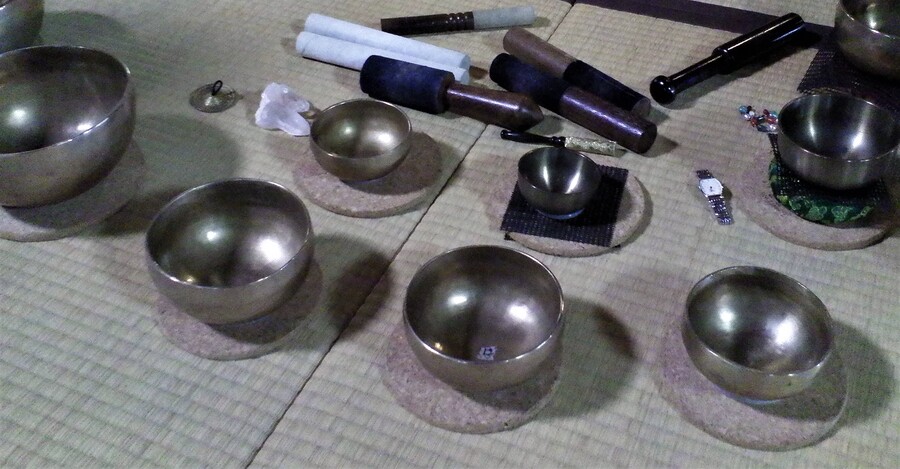
Un sonido constante, suave y predecible —un cuenco que se apaga lentamente, una voz sostenida— es para tu sistema de alarma una señal de que no hay peligro. A eso súmale que en un baño de sonido estás acostado, inmóvil, con los ojos cerrados y respirando lento: todas las condiciones del freno activadas al mismo tiempo. La vibración hace el resto: el cuerpo la recibe como un masaje de ondas, los sentidos se recogen hacia adentro, y la mente tiene un solo objeto que seguir.
A steady, soft, predictable sound —a bowl fading slowly, a sustained voice— is, to your alarm system, a signal that there's no danger. Add to that the fact that in a sound bath you're lying down, still, with your eyes closed and breathing slowly: all the conditions of the brake switched on at the same time. The vibration does the rest: the body receives it as a massage of waves, the senses gather inward, and the mind has a single object to follow.
El yoga llegó aquí hace siglos, otra vez: el nāda yoga es la rama dedicada al sonido como camino de meditación, y la Haṭha Yoga Pradīpikā (siglo XV) describe bhrāmarī, la respiración de la abeja: exhalar zumbando. El zumbido alarga la exhalación —el freno del corazón— y llena el cráneo de vibración. Es sound healing hecho solo con tu voz.
Yoga arrived here centuries ago, once again: nāda yoga is the branch devoted to sound as a path of meditation, and the Haṭha Yoga Pradīpikā (15th century) describes bhrāmarī, the bee breath: exhaling with a hum. The humming lengthens the exhale —the heart's brake— and fills the skull with vibration. It's sound healing made with your voice alone.
Para practicar hoyTo practice today
1. Bhrāmarī, la respiración de la abeja1. Bhrāmarī, the bee breath
Siéntate en una posición cómoda, cierra los ojos e inhala por la nariz. Al exhalar, con la boca cerrada, haz un zumbido grave y sostenido —como una abeja— hasta vaciarte. Siente dónde vibra: el pecho, la garganta, la cara. Repite de cinco a diez veces. Si quieres más intensidad, tapa suavemente tus oídos con los pulgares: la vibración se escucha entera por dentro.
Sit in a comfortable position, close your eyes, and inhale through the nose. As you exhale, with your mouth closed, make a low, sustained hum —like a bee— until you're empty. Feel where it vibrates: the chest, the throat, the face. Repeat five to ten times. If you want more intensity, gently cover your ears with your thumbs: the vibration is heard whole from within.
2. Seguir un sonido hasta el final2. Follow a sound to its end
Toca una campana, un cuenco o una nota de cualquier instrumento, y sigue el sonido con toda tu atención hasta que desaparezca por completo. El momento exacto en que el sonido se vuelve silencio es difícil de soltar — y por eso es un entrenamiento perfecto de concentración. Tres campanadas bastan.
Strike a bell, a bowl, or a note from any instrument, and follow the sound with all your attention until it disappears completely. The exact moment when the sound becomes silence is hard to let go of — and that's why it's a perfect training in concentration. Three strikes are enough.
3. Un baño de sonido3. A sound bath
Si nunca has ido a uno: te recuestas cómodamente en el piso, te tapas con una cobija si quieres, y durante 45 a 60 minutos suenan cuencos, gongs y campanas a tu alrededor. No tienes que hacer nada — esa es la práctica. Las primeras veces la mente comenta todo; déjala. El cuerpo entiende solo.
If you've never been to one: you lie down comfortably on the floor, cover yourself with a blanket if you like, and for 45 to 60 minutes bowls, gongs, and bells sound all around you. You don't have to do anything — that's the practice. The first few times the mind comments on everything; let it. The body understands on its own.
Los ojos se cierran; los oídos, nunca. El sonido es el arte que entra sin pedir permiso, y por eso es uno de los caminos más directos hacia adentro.
The eyes close; the ears, never. Sound is the art that enters without asking permission, and that's why it's one of the most direct paths inward.
ReferenciasReferences
- de Witte, M., Spruit, A., van Hooren, S., Moonen, X. y Stams, G. J. (2020). Effects of music interventions on stress-related outcomes: a systematic review and two meta-analyses. Health Psychology Review, 14(2), 294–324. doi:10.1080/17437199.2019.1627897
- Goldsby, T. L., Goldsby, M. E., McWalters, M. y Mills, P. J. (2017). Effects of singing bowl sound meditation on mood, tension, and well-being: an observational study. Journal of Evidence-Based Complementary & Alternative Medicine, 22(3), 401–406. doi:10.1177/2156587216668109
- Garcia-Argibay, M., Santed, M. A. y Reales, J. M. (2019). Efficacy of binaural auditory beats in cognition, anxiety, and pain perception: a meta-analysis. Psychological Research, 83(2), 357–372. doi:10.1007/s00426-018-1066-8
- Iaccarino, H. F. et al. (2016). Gamma frequency entrainment attenuates amyloid load and modifies microglia. Nature, 540, 230–235.
- Martorell, A. J. et al. (2019). Multi-sensory gamma stimulation ameliorates Alzheimer's-associated pathology and improves cognition. Cell, 177(2), 256–271.
- Chladni, E. F. F. (1787). Entdeckungen über die Theorie des Klanges (Descubrimientos sobre la teoría del sonido)(Discoveries in the Theory of Sound). Leipzig.
- Jenny, H. (1967). Kymatik (Cimática)(Cymatics). Basilea: Basilius Presse.
- Carroll, S. (2012). The Particle at the End of the Universe. Dutton. (Sobre la materia como vibración de campos cuánticos.)(On matter as the vibration of quantum fields.)
- Berendt, J.-E. (1983). Nada Brahma: El mundo es sonido. (Sobre el nāda yoga y la tradición del sonido.)(On nāda yoga and the tradition of sound.)
- Svātmārāma. Haṭha Yoga Pradīpikā (siglo XV), capítulo 2 (bhrāmarī)(15th century), chapter 2 (bhrāmarī).
Créditos de imágenes: Video y fotografías de placas de Chladni: Estes Objethos Atelier (CC BY-SA 4.0). Cuencos tibetanos: G. P. Witteveen (CC BY-SA 4.0). Vía Wikimedia Commons.
Image credits: Video and photographs of Chladni plates: Estes Objethos Atelier (CC BY-SA 4.0). Tibetan bowls: G. P. Witteveen (CC BY-SA 4.0). Via Wikimedia Commons.