
Por NuzaBy Nuza
«La energía sigue a la atención.» Principio del yoga
"Energy follows attention." A yoga principle
Casi cualquiera que haya pisado una clase de yoga ha oído la palabra «chakra»: el del corazón, el de la garganta, el de la raíz. La tradición del yoga describe siete centros de energía alineados a lo largo de la columna, desde la base hasta la coronilla. Cada uno es como una rueda que gira — eso significa chakra en sánscrito, «rueda» — y por la que circula tu energía vital, el prāṇa.
Almost anyone who has ever set foot in a yoga class has heard the word "chakra": the heart one, the throat one, the root one. The yoga tradition describes seven energy centers lined up along the spine, from the base to the crown. Each one is like a spinning wheel — that's what chakra means in Sanskrit, "wheel" — and through it circulates your vital energy, prāṇa.
No hace falta que los imagines como aparatos dentro del cuerpo. Piénsalos como un mapa: una forma de ponerle nombre y lugar a cosas que ya sientes. El miedo que se planta en el vientre, el nudo en la garganta cuando algo no se dice, el pecho que se abre cuando quieres a alguien. El yoga lleva siglos usando este mapa para entender por dónde anda tu energía y dónde se atora.
You don't need to imagine them as devices inside the body. Think of them as a map: a way to give a name and a place to things you already feel. The fear that settles in your belly, the knot in your throat when something goes unsaid, the chest that opens up when you love someone. Yoga has spent centuries using this map to understand where your energy is moving and where it gets stuck.
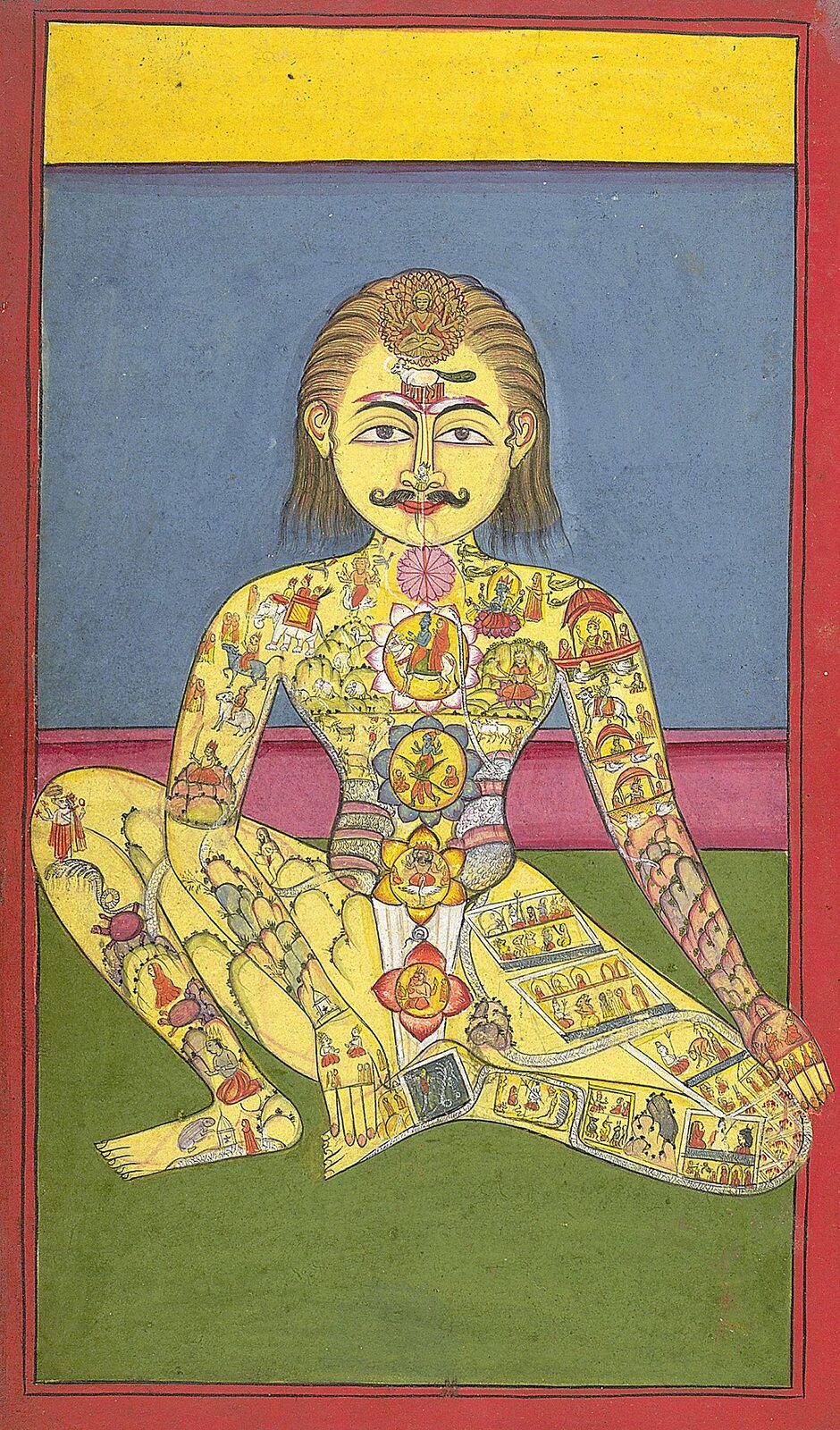
Cómo funciona el mapa
How the map works
Los siete chakras suben en línea, uno sobre otro. Los de abajo te conectan con lo más terrenal — el cuerpo, la seguridad, los vínculos — y, conforme subes, se vuelven más sutiles — la expresión, la intuición, la consciencia —. La idea no es que unos sean «mejores» que otros: un chakra que se siente abierto y en calma deja correr la energía; uno tenso o apagado la atora, y eso se nota en cómo te sientes.
The seven chakras rise in a line, one above the other. The lower ones connect you with what's most earthly — the body, safety, your bonds — and, as you go up, they become more subtle — expression, intuition, consciousness. The idea isn't that some are "better" than others: a chakra that feels open and calm lets the energy flow; a tense or dimmed one holds it back, and you can tell in how you feel.
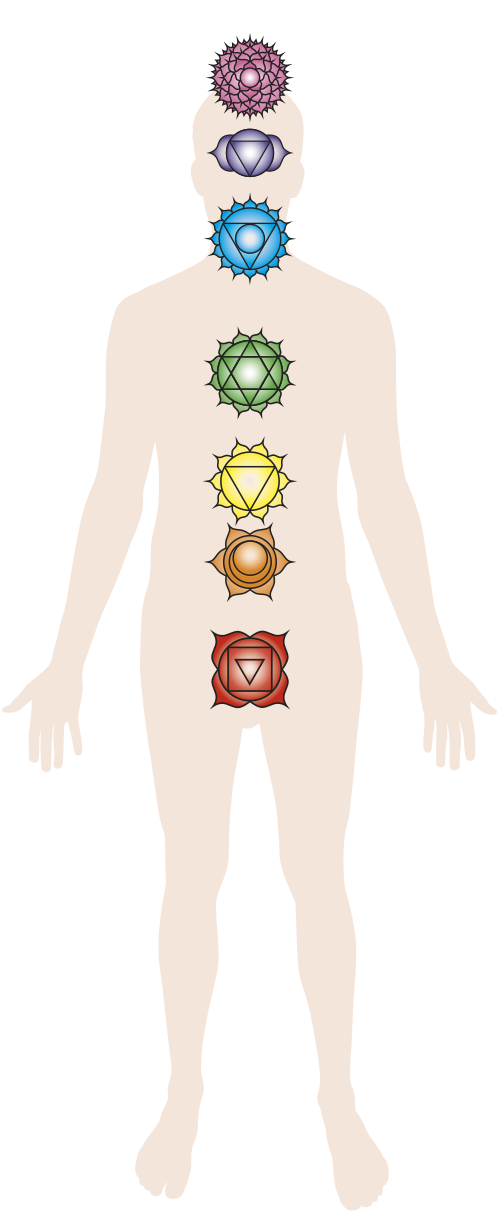
Cada chakra tiene además su propio símbolo, un yantra: un loto con cierto número de pétalos y, en el centro, una figura geométrica que representa su elemento y su energía. Trabajar un chakra en el yoga suele ser una combinación de tres cosas: postura (abrir físicamente esa zona del cuerpo), atención (llevar la mente ahí) y a veces sonido (cada centro tiene una sílaba, su bīja mantra). Vamos uno por uno, de abajo hacia arriba.
Each chakra also has its own symbol, a yantra: a lotus with a certain number of petals and, at the center, a geometric figure that represents its element and its energy. Working a chakra in yoga is usually a combination of three things: posture (physically opening that area of the body), attention (bringing the mind there), and sometimes sound (each center has a syllable, its bīja mantra). Let's go one by one, from the bottom up.
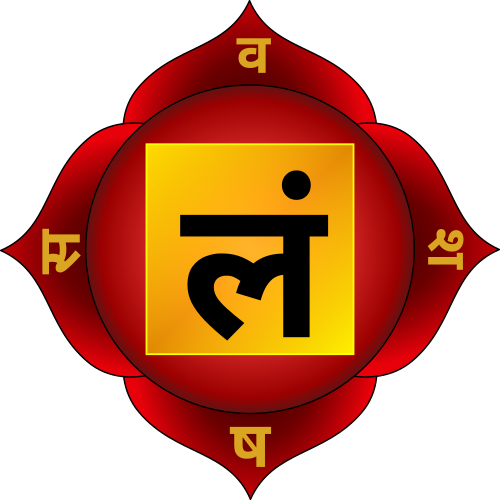
1. Mūlādhāra — raíz
Es tu cimiento. Tiene que ver con sentirte sostenido: el cuerpo, la casa, el dinero, la pertenencia, la sensación de tener un lugar en el mundo. Cuando está firme, te sientes seguro y con los pies en la tierra; cuando flaquea, aparece el miedo y la inquietud de base. Se trabaja con posturas de conexión al suelo y de piernas — la montaña, la silla, las sentadillas, posturas de pie firmes — y llevando la atención al perineo y a las plantas de los pies.
Cuatro pétalos y, en el centro, un cuadrado amarillo — la tierra, lo sólido y estable — con un triángulo apuntando hacia abajo.
1. Mūlādhāra — root
It's your foundation. It has to do with feeling held: the body, your home, money, belonging, the sense of having a place in the world. When it's steady, you feel safe and grounded; when it falters, fear and a baseline restlessness show up. You work it with grounding and standing-leg postures — mountain, chair, squats, firm standing poses — and by bringing attention to the perineum and the soles of the feet.
Four petals and, at the center, a yellow square — earth, the solid and stable — with a downward-pointing triangle.
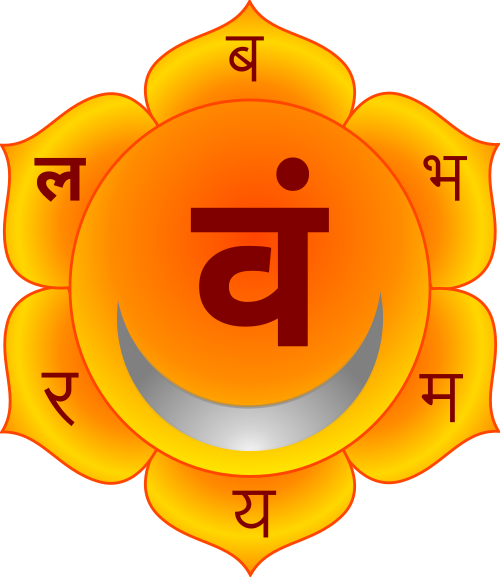
2. Svādhiṣṭhāna — sacro
El centro del placer, la emoción y la creatividad. Es agua: fluidez, deseo, capacidad de sentir y de disfrutar. Cuando fluye, te mueves con soltura y te permites gozar; cuando se bloquea, aparece la rigidez emocional o la culpa. Se trabaja con aperturas de cadera y movimientos circulares de la pelvis — la diosa, la paloma, el círculo de cadera —.
Seis pétalos y, en el centro, una luna creciente: el agua, las mareas, todo lo que fluye y cambia.
2. Svādhiṣṭhāna — sacral
The center of pleasure, emotion, and creativity. It's water: flow, desire, the capacity to feel and to enjoy. When it flows, you move with ease and let yourself enjoy; when it gets blocked, emotional stiffness or guilt show up. You work it with hip openers and circular movements of the pelvis — goddess, pigeon, hip circles.
Six petals and, at the center, a crescent moon: water, the tides, everything that flows and changes.
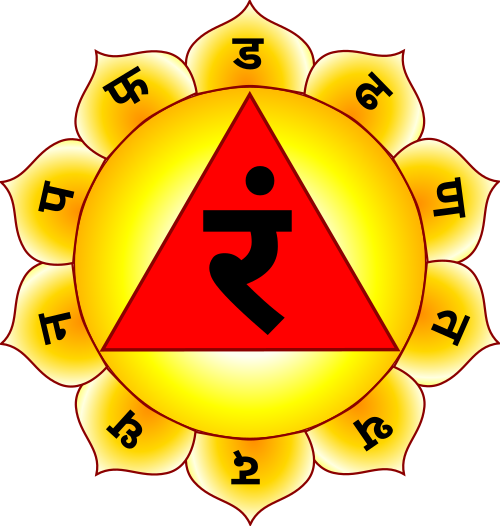
3. Maṇipūra — plexo solar
Tu fuego. Aquí viven la voluntad, la confianza y el poder personal: la capacidad de decidir y de actuar. Cuando arde bien, te sientes capaz y con dirección; cuando se apaga, llega la inseguridad o la pasividad. Se trabaja con torsiones, posturas que encienden el centro — la barca, la tabla, el guerrero — y con respiraciones que avivan el calor.
Diez pétalos y, en el centro, un triángulo apuntando hacia abajo: el fuego, la energía que transforma — como la digestión convierte la comida en energía.
3. Maṇipūra — solar plexus
Your fire. This is where willpower, confidence, and personal power live: the capacity to decide and to act. When it burns well, you feel capable and with direction; when it goes out, insecurity or passivity move in. You work it with twists, postures that light up the center — boat, plank, warrior — and with breaths that fan the heat.
Ten petals and, at the center, a downward-pointing triangle: fire, the energy that transforms — the way digestion turns food into energy.
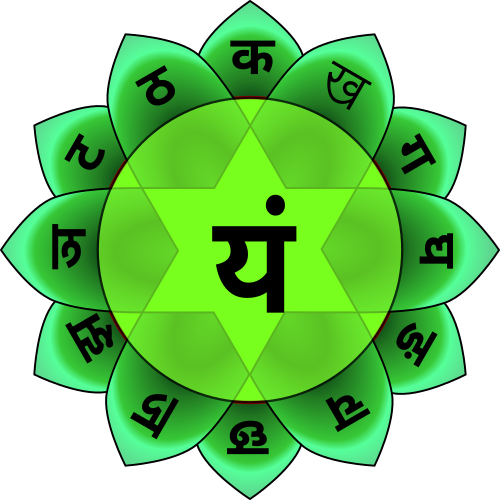
4. Anāhata — corazón
El puente entre los tres centros de abajo (lo terrenal) y los tres de arriba (lo sutil). Es el amor, la compasión, la capacidad de dar y de recibir. Cuando está abierto, te vinculas sin miedo; cuando se cierra, llega la coraza o el desamor. Se trabaja con aperturas de pecho — el camello, el puente, el pez, la cobra — y con cualquier movimiento que te abra el pecho.
Doce pétalos y, en el centro, dos triángulos entrelazados — uno apunta hacia arriba y otro hacia abajo —, formando una estrella de seis puntas: la misma figura que la estrella de David. Es la imagen perfecta de lo que hace el corazón: el punto donde lo que sube de la tierra y lo que baja del cielo se encuentran y se equilibran.
4. Anāhata — heart
The bridge between the three lower centers (the earthly) and the three upper ones (the subtle). It's love, compassion, the capacity to give and to receive. When it's open, you connect without fear; when it closes, an armor or a hardening of the heart sets in. You work it with chest openers — camel, bridge, fish, cobra — and with any movement that opens the chest.
Twelve petals and, at the center, two interlocking triangles — one pointing up and one pointing down — forming a six-pointed star: the same figure as the Star of David. It's the perfect image of what the heart does: the point where what rises from the earth and what descends from the sky meet and find their balance.
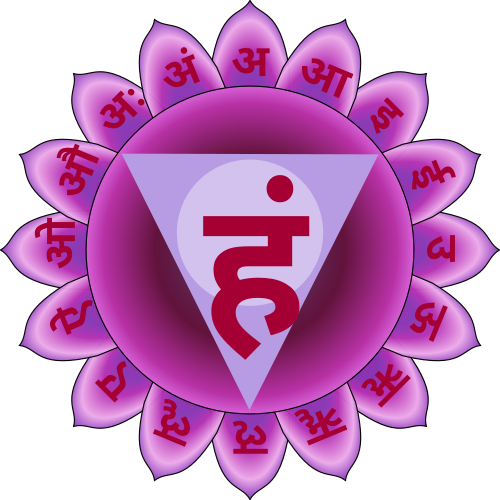
5. Viśuddha — garganta
El centro de la expresión y la verdad: poder decir lo que eres y lo que sientes. Cuando fluye, hablas claro y escuchas bien; cuando se atora, aparece el nudo, lo no dicho, la voz que se queda dentro. Se trabaja con posturas que abren el cuello y la garganta — el pez, el arado, el puente — y, muy directamente, con el sonido: cantar, recitar, o la respiración ujjayi, que pasa justo por ahí.
Dieciséis pétalos y, en el centro, un triángulo apuntando hacia abajo con un círculo dentro: el espacio, el éter, lo que vibra y se propaga como el sonido.
5. Viśuddha — throat
The center of expression and truth: being able to say what you are and what you feel. When it flows, you speak clearly and listen well; when it gets stuck, there's the knot, the unsaid, the voice that stays inside. You work it with postures that open the neck and throat — fish, plow, bridge — and, very directly, with sound: singing, chanting, or ujjayi breath, which passes right through there.
Sixteen petals and, at the center, a downward-pointing triangle with a circle inside: space, ether, what vibrates and travels like sound.
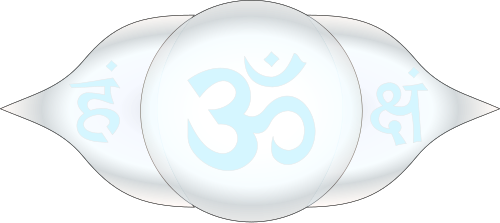
6. Ājñā — tercer ojo
La intuición y la claridad: ver más allá de lo evidente, esa sensación de «saber» sin razonarlo. Cuando está despejado, confías en tu percepción; cuando se nubla, llega la confusión o el exceso de análisis. Se trabaja sobre todo con la quietud: la atención en el entrecejo, la mirada interna, la meditación y posturas de recogimiento como la pinza o la postura del niño.
Tiene solo dos pétalos, uno a cada lado, como dos alas o dos ojos. En el centro, el sonido OM. Aquí los grandes canales de energía del cuerpo se reúnen en uno solo: por eso se le llama el centro del mando.
6. Ājñā — third eye
Intuition and clarity: seeing beyond the obvious, that sense of "knowing" without reasoning it out. When it's clear, you trust your perception; when it clouds over, confusion or over-analysis set in. You work it mostly with stillness: attention between the brows, the inner gaze, meditation, and inward postures like the forward fold or child's pose.
It has only two petals, one on each side, like two wings or two eyes. At the center, the sound OM. Here the body's great energy channels gather into one: that's why it's called the command center.
7. Sahasrāra — corona
El más sutil: la conexión con algo más grande que tú, la consciencia, lo que en distintas tradiciones se llama lo divino o la unidad. No se «hace», se permite. Se cultiva con la meditación, el silencio y la entrega — savasana es, en cierto modo, su postura.
Es el loto de los mil pétalos: tantos que ya no se cuentan. No tiene un elemento ni una sílaba concreta — representa la apertura total, lo que está más allá de las palabras.
7. Sahasrāra — crown
The most subtle: the connection with something greater than you, consciousness, what different traditions call the divine or oneness. You don't "do" it, you allow it. It's cultivated through meditation, silence, and surrender — savasana is, in a way, its posture.
It's the thousand-petaled lotus: so many they can no longer be counted. It has no particular element or syllable — it represents total openness, what lies beyond words.
Para llevarlo a tu práctica
Bringing it into your practice
Una pasada por tus siete centros
Siéntate cómodo y cierra los ojos. Lleva la atención a la base de la columna y respira ahí unas tres veces, como si dejaras peso en el suelo. Luego sube: al bajo vientre, a la boca del estómago, al centro del pecho, a la garganta, al entrecejo, a la coronilla — tres respiraciones en cada uno. No busques sentir nada espectacular; solo nota. Al terminar, quédate un momento sintiendo toda la columna encendida de abajo a arriba.
A pass through your seven centers
Sit comfortably and close your eyes. Bring your attention to the base of the spine and breathe there about three times, as if you were leaving weight on the floor. Then move up: to the lower belly, the pit of the stomach, the center of the chest, the throat, between the brows, the crown — three breaths at each one. Don't try to feel anything spectacular; just notice. When you finish, stay a moment feeling the whole spine lit up from the bottom to the top.
No tienes que creer en nada para que el mapa te sirva. Es una manera de escucharte por partes: de notar dónde hay vida y dónde hay tensión, y de llevar la práctica — postura, respiración, atención — justo ahí.
You don't have to believe in anything for the map to be useful. It's a way of listening to yourself in parts: noticing where there's life and where there's tension, and bringing the practice — posture, breath, attention — right there.
Referencias
References
- Saraswati, Swami Satyananda (1996). Kuṇḍalinī Tantra. Bihar School of Yoga. (Descripción tradicional de los chakras y sus símbolos.)
- Saraswati, Swami Satyananda (1996). Asana Pranayama Mudra Bandha. Bihar School of Yoga.
- Avalon, Arthur (Sir John Woodroffe) (1919). The Serpent Power. (Traducción y comentario del Ṣaṭ-Cakra-Nirūpaṇa, fuente clásica del sistema de los siete chakras.)
- Judith, Anodea (2004). Eastern Body, Western Mind. Celestial Arts.
- Mallinson, J. y Singleton, M. (2017). Roots of Yoga. Penguin Classics. (Contexto histórico del cuerpo sutil.)
- Saraswati, Swami Satyananda (1996). Kuṇḍalinī Tantra. Bihar School of Yoga. (Traditional description of the chakras and their symbols.)
- Saraswati, Swami Satyananda (1996). Asana Pranayama Mudra Bandha. Bihar School of Yoga.
- Avalon, Arthur (Sir John Woodroffe) (1919). The Serpent Power. (Translation and commentary of the Ṣaṭ-Cakra-Nirūpaṇa, the classic source for the seven-chakra system.)
- Judith, Anodea (2004). Eastern Body, Western Mind. Celestial Arts.
- Mallinson, J. and Singleton, M. (2017). Roots of Yoga. Penguin Classics. (Historical context of the subtle body.)
Créditos de imágenes: «Sapta Chakra» (manuscrito, 1899), dominio público. Diagrama del cuerpo y símbolos tradicionales de los siete chakras, vía Wikimedia Commons (CC BY-SA 3.0).
Image credits: "Sapta Chakra" (manuscript, 1899), public domain. Body diagram and traditional symbols of the seven chakras, via Wikimedia Commons (CC BY-SA 3.0).