
Por NuzaBy Nuza
«La masa y la energía son manifestaciones distintas de una misma cosa.» Albert Einstein (1948)
"Mass and energy are different manifestations of the same thing." Albert Einstein (1948)
«Todos somos energía» es una de esas frases que se repiten mucho y casi nunca se explican. Pero resulta que es cierta, y de una forma más concreta de lo que parece: no en un sentido vago, sino físico y medible, que está pasando dentro de ti en este momento.
"We are all energy" is one of those phrases that gets repeated a lot and almost never explained. But it turns out to be true, and in a more concrete way than it seems: not in some vague sense, but in a physical, measurable one that is happening inside you right now.
En este artículo vamos a ver en qué sentido eres literalmente energía —la física y la biología tienen respuestas claras—, qué intuyó el yoga hace miles de años con eso que llamó prana, y dónde termina lo que se puede medir y empieza lo que solo se puede vivir.
In this article we'll look at the sense in which you are literally energy —physics and biology have clear answers—, what yoga intuited thousands of years ago with what it called prana, and where what can be measured ends and what can only be lived begins.
Lo que parece sólido casi no lo esWhat seems solid barely is
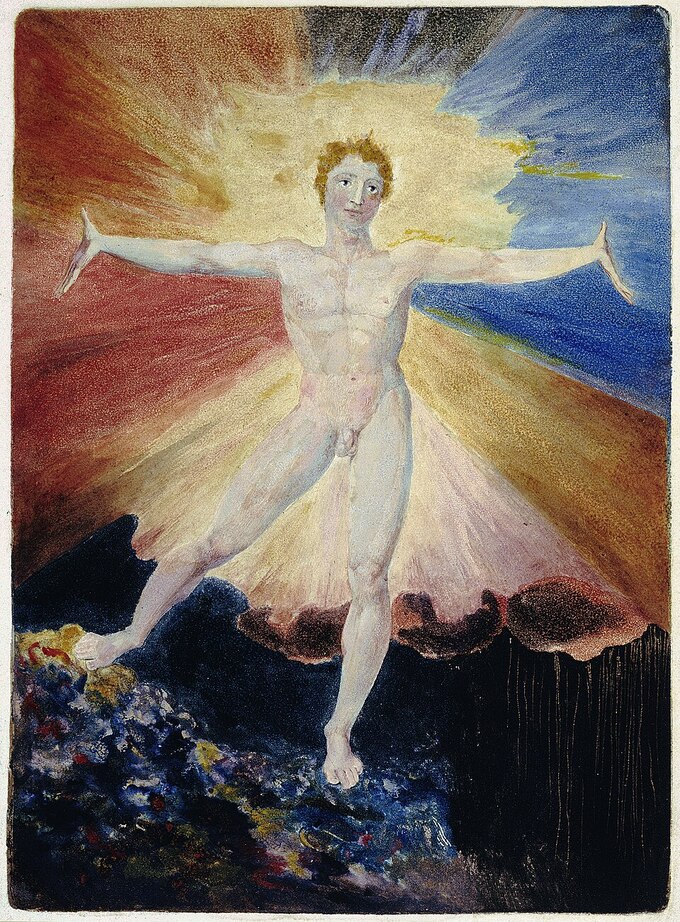
Empecemos por lo más raro. Tu mano se siente sólida, pero está hecha de átomos, y un átomo es casi todo espacio vacío: el centro (el núcleo) ocupa una parte minúscula, y el resto es hueco. ¿Qué tan vacío? Tanto que más del 99,9% de ti es, en realidad, espacio vacío. Si pudieras quitarle a tu cuerpo todo ese hueco y dejar solo la materia, lo que quedaría sería tan pequeño que casi no se alcanzaría a ver. Lo que tocas y sientes firme es, en su enorme mayoría, vacío atravesado por fuerzas.
Let's start with the strangest part. Your hand feels solid, but it's made of atoms, and an atom is almost all empty space: the center (the nucleus) takes up a tiny part, and the rest is hollow. How empty? So empty that more than 99.9% of you is, in fact, empty space. If you could take all that hollow space out of your body and leave only the matter, what remained would be so small you could barely see it. What you touch and feel as firm is, overwhelmingly, emptiness crossed by forces.
Y aún más: a principios del siglo XX, Einstein mostró con su famosa ecuación E = mc² que la masa y la energía son lo mismo, en dos formas distintas. La materia es, en el fondo, energía muy concentrada. Eso que llamas «tu cuerpo» no está hecho de ladrillos sólidos, sino de energía organizada en patrones. Así que «somos energía» es, literalmente, el punto de partida de la física.
And there's more: in the early twentieth century, Einstein showed with his famous equation E = mc² that mass and energy are the same thing in two different forms. Matter is, deep down, highly concentrated energy. What you call "your body" isn't made of solid bricks, but of energy organized into patterns. So "we are energy" is, literally, the starting point of physics.
Tu cuerpo funciona con electricidadYour body runs on electricity
Bajemos del átomo al cuerpo, donde se pone todavía más interesante. Tú funcionas, literalmente, con electricidad.
Let's come down from the atom to the body, where it gets even more interesting. You run, literally, on electricity.
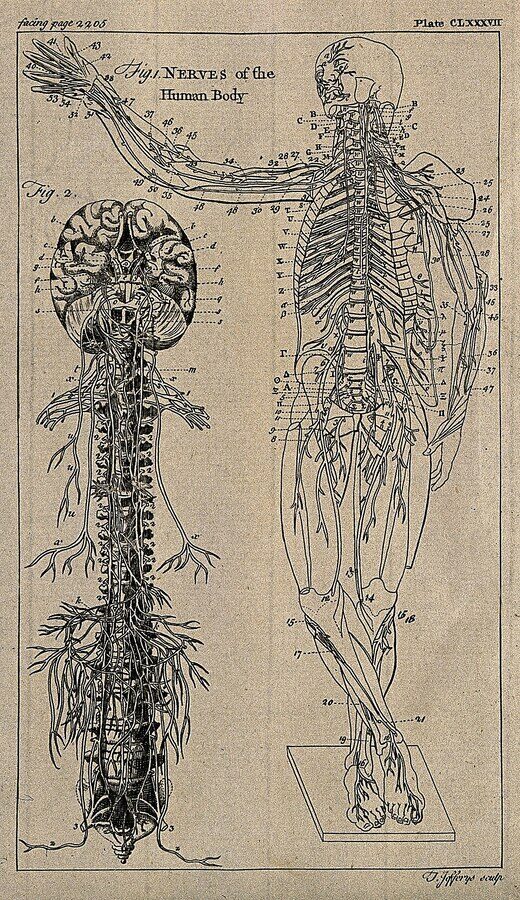
Cada vez que piensas, mueves un dedo o sientes algo, lo que viaja por tus nervios es un impulso eléctrico: una pequeña descarga que corre por ellos como la corriente por un cable. Dos científicos de la Universidad de Cambridge lo midieron directamente y comprobaron que tus neuronas se comunican exactamente así, con descargas eléctricas una tras otra (Hodgkin y Huxley, 1952).
Every time you think, move a finger, or feel something, what travels through your nerves is an electrical impulse: a small charge that runs along them like current through a wire. Two scientists at the University of Cambridge measured it directly and confirmed that your neurons communicate exactly this way, with electrical discharges one after another (Hodgkin and Huxley, 1952).
No son solo las neuronas. Tu corazón late porque una onda eléctrica lo recorre; eso es justo lo que mide un electrocardiograma. Tu cerebro emite ritmos eléctricos que registra un electroencefalograma. Y cada una de tus células —los billones que te forman— mantiene una pequeña diferencia de carga entre su interior y su exterior, como una pila diminuta, gracias a unas compuertas en su membrana. Eres, medido con aparatos, un ser eléctrico de pies a cabeza.
And it's not just the neurons. Your heart beats because an electrical wave runs through it; that's exactly what an electrocardiogram measures. Your brain gives off electrical rhythms that an electroencephalogram records. And each of your cells —the trillions that make you up— holds a small difference in charge between its inside and its outside, like a tiny battery, thanks to gates in its membrane. You are, measured with instruments, an electrical being from head to toe.
La electricidad no solo te mueve: te construyeElectricity doesn't just move you: it builds you
Aquí viene un dato que poca gente conoce. Esa electricidad celular no solo te hace funcionar; ayuda a darte forma. El biólogo Michael Levin, de la Universidad de Tufts, ha demostrado que las células usan señales eléctricas para «ponerse de acuerdo» sobre qué construir y dónde: dónde va un ojo, cómo se regenera un tejido, qué forma toma un organismo. Cambiando esas señales eléctricas, su equipo ha logrado que crezcan estructuras nuevas (Levin, 2021).
Here's something few people know. That cellular electricity doesn't just make you function; it helps give you shape. The biologist Michael Levin, of Tufts University, has shown that cells use electrical signals to "agree" on what to build and where: where an eye goes, how a tissue regenerates, what shape an organism takes. By changing those electrical signals, his team has made new structures grow (Levin, 2021).
Dicho de otro modo: hay una capa de información eléctrica que organiza la materia viva. No eres una estatua de carne; eres un patrón de energía que se sostiene y se rehace todo el tiempo. La vida, vista de cerca, se parece más a una corriente que a una cosa.
Put another way: there's a layer of electrical information that organizes living matter. You're not a statue of flesh; you're a pattern of energy that holds itself together and remakes itself all the time. Life, seen up close, looks more like a current than a thing.
Lo que el yoga llamó pranaWhat yoga called prana
Mucho antes de los electrocardiogramas, el yoga ya hablaba de esto a su manera. Lo llamó prana: la energía vital, el aliento que anima al cuerpo. Para esa tradición, no estamos hechos solo de carne, sino de una fuerza que circula y nos mantiene vivos — y el trabajo central del yoga, el prāṇāyāma, es precisamente regular esa energía a través de la respiración.
Long before electrocardiograms, yoga was already talking about this in its own way. It called it prana: the vital energy, the breath that animates the body. For that tradition, we're not made of flesh alone, but of a force that circulates and keeps us alive — and the central work of yoga, prāṇāyāma, is precisely to regulate that energy through the breath.
No hay que forzar la traducción para ver el puente. La intuición —que somos algo más dinámico que pura materia inerte, que hay una energía que nos recorre— coincide con lo que hoy la ciencia describe como bioelectricidad y metabolismo. Y hay un punto donde el puente es directo y comprobado: la respiración cambia, en segundos, el estado eléctrico de tu sistema nervioso. Respirar lento literalmente reconfigura las señales que recorren tu cuerpo (lo explicamos a fondo en este artículo). El yoga descubrió, por la vía de la experiencia, una palanca real sobre tu energía.
You don't have to stretch the comparison to see the bridge. The intuition —that we are something more dynamic than pure inert matter, that there's an energy running through us— matches what science today describes as bioelectricity and metabolism. And there's a point where the bridge is direct and proven: breathing changes, in seconds, the electrical state of your nervous system. Breathing slowly literally reconfigures the signals that run through your body (we explain it in depth in this article). Yoga discovered, through experience, a real lever over your energy.
Dónde termina lo medido y empieza lo vividoWhere the measured ends and the lived begins
Hasta aquí lo que la ciencia puede medir: tu cuerpo es energía, eléctrica y viva. Pero hay una parte que ningún aparato registra y que tú conoces bien: cómo se siente esa energía. La diferencia entre llegar al tapete arrastrando el día y salir ligera. Eso no se mide en un laboratorio; se vive en el cuerpo.
So far, what science can measure: your body is energy, electrical and alive. But there's a part no instrument records and that you know well: how that energy feels. The difference between arriving at the mat dragging the day behind you and leaving light. That isn't measured in a laboratory; it's lived in the body.
Y no necesitas creer en nada para notarlo. Cuando en una clase escuchas «mueve tu energía», con cada respiración y cada movimiento estás cambiando de verdad tu circulación, tu química y el estado eléctrico de tu sistema nervioso. El yoga no te pide fe: te invita a sentir, en tu propio cuerpo, eso que la física apenas empieza a explicar.
And you don't need to believe anything to notice it. When you hear "move your energy" in a class, with each breath and each movement you really are changing your circulation, your chemistry, and the electrical state of your nervous system. Yoga doesn't ask you for faith: it invites you to feel, in your own body, what physics is only beginning to explain.
Para sentirlo hoyTo feel it today
Nota tu propia energía cambiarNotice your own energy shift
Siéntate un momento y registra cómo te sientes: el pulso, la temperatura de las manos, qué tan acelerada va la mente. Luego haz diez respiraciones lentas, alargando la exhalación. Vuelve a registrar. Ese cambio que notas —manos más tibias, pulso más calmado, mente más quieta— es, literalmente, tu energía reorganizándose. No tuviste que creer nada: solo respiraste, y el sistema respondió.
Sit for a moment and take note of how you feel: your pulse, the temperature of your hands, how fast your mind is racing. Then take ten slow breaths, lengthening the exhale. Take note again. That shift you notice —warmer hands, a calmer pulse, a quieter mind— is, literally, your energy reorganizing itself. You didn't have to believe anything: you just breathed, and the system responded.
Eres energía en movimiento. Y la práctica no es más que aprender a habitarla con un poco más de conciencia.
You are energy in motion. And the practice is nothing more than learning to inhabit it with a little more awareness.
ReferenciasReferences
- Einstein, A. (1905). Ist die Trägheit eines Körpers von seinem Energieinhalt abhängig? Annalen der Physik. (Origen de la equivalencia masa-energía, E = mc²; la cita es de su declaración de 1948.)
- Hodgkin, A. L. y Huxley, A. F. (1952). A quantitative description of membrane current and its application to conduction and excitation in nerve. The Journal of Physiology, 117(4), 500–544. (Universidad de Cambridge.)
- Levin, M. (2021). Bioelectric signaling: reprogrammable circuits underlying embryogenesis, regeneration, and cancer. Cell, 184(8), 1971–1989. (Universidad de Tufts.)
- Prashna Upanishad y Haṭha Yoga Pradīpikā. (Textos clásicos sobre el prāṇa como energía vital y el prāṇāyāma como su regulación.)
- Einstein, A. (1905). Ist die Trägheit eines Körpers von seinem Energieinhalt abhängig? Annalen der Physik. (Origin of the mass–energy equivalence, E = mc²; the quote is from his 1948 statement.)
- Hodgkin, A. L. and Huxley, A. F. (1952). A quantitative description of membrane current and its application to conduction and excitation in nerve. The Journal of Physiology, 117(4), 500–544. (University of Cambridge.)
- Levin, M. (2021). Bioelectric signaling: reprogrammable circuits underlying embryogenesis, regeneration, and cancer. Cell, 184(8), 1971–1989. (Tufts University.)
- Prashna Upanishad and Haṭha Yoga Pradīpikā. (Classical texts on prāṇa as vital energy and prāṇāyāma as its regulation.)